
On August 6, the first tranche of locked-up SpaceX shares was released. Roughly 911.5 million shares became eligible to trade in a single session.
SPCX went up 6%.
Then it went up again the next day, closing out a two-day gain of about 11% on the exact event everybody had circled on their calendar as the plunge.
I had circled it too.
The Consensus Was Obvious, And Obviously Wrong
SpaceX's public float before that day was about 639 million shares. The unlock added roughly 143% to the tradeable supply overnight.
Put another way, the freely tradable portion of the company went from about 4.9% of shares outstanding to about 11.8%. The float more than doubled, from roughly 639 million shares to about 1.55 billion.
Short interest had built up in anticipation. Every reasonable person expected a flood of seller to push the stock price below $100.
The sellers didn't show, and I wasn't able to buy the dip as a result.
Why The SpaceX Sellers Didn't Show
The relative pain had already been taken.
Shares IPO'd at $135 on June 11 and spiked above $225 in the first days of trading. Then they fell more than 50% to close at $108.27 on August 5, after the company's first public quarterly results.
Every share of that decline was sold by the free float. The locked-up holders couldn't participate. Only the roughly 639 million shares that could trade from day one were doing any of the damage.
People who could sell spent seven weeks selling ahead of people who couldn't, and short sellers piled on top of them. By August 6, the supply everyone was bracing for had already been front-run.
Then two things happened at once.
The shorts had no flood to sell into, so some of them covered (bought).
And the newly freed holders opened their screens to a stock down more than 50% from its high and sitting below its IPO price. If you've held SpaceX privately for a decade with a cost basis in the single digits, you are in no rush to hit the bid at the local low. You've waited 20 years. You can wait a few more weeks or months.
The staggered structure helped too.
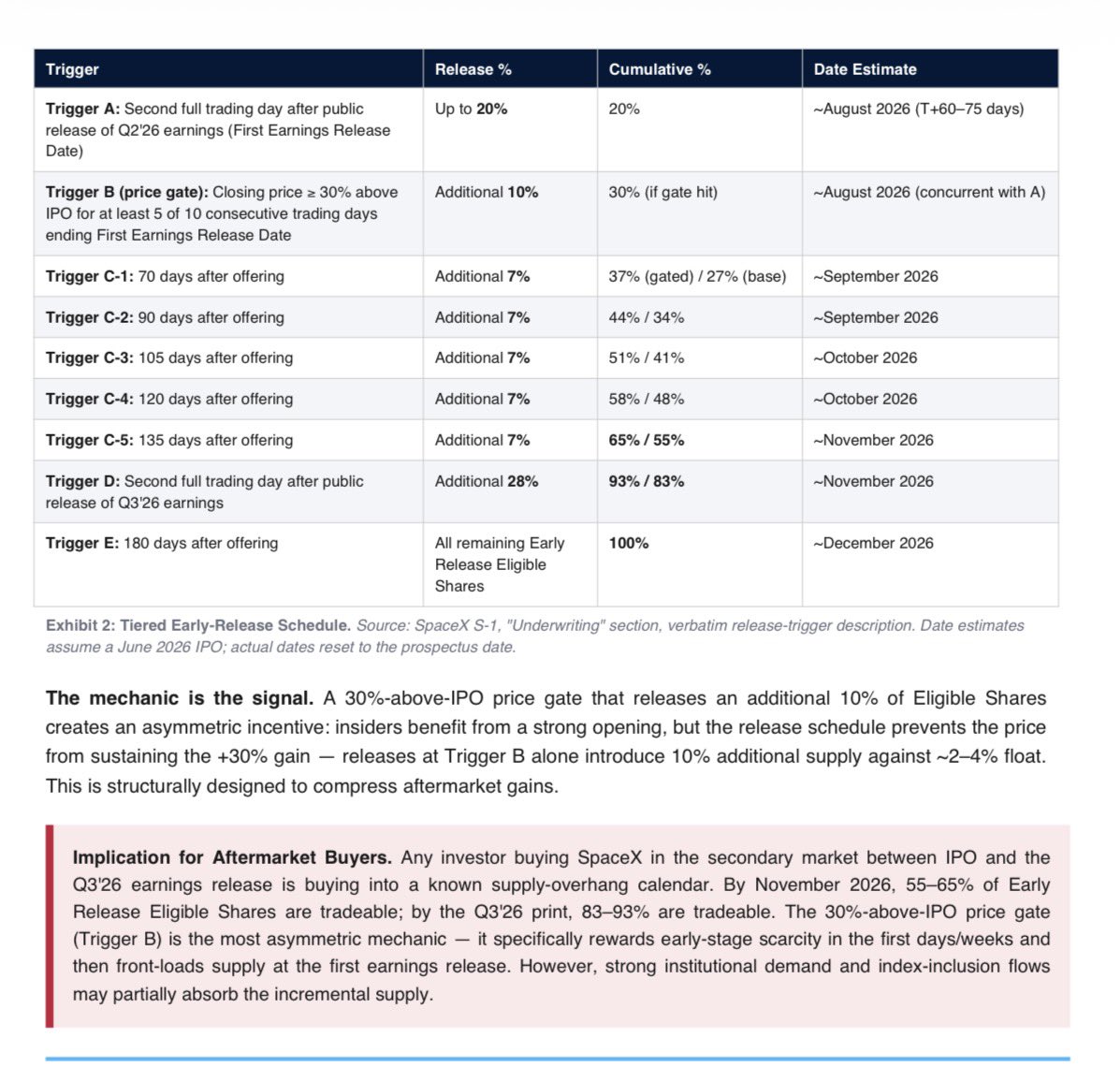
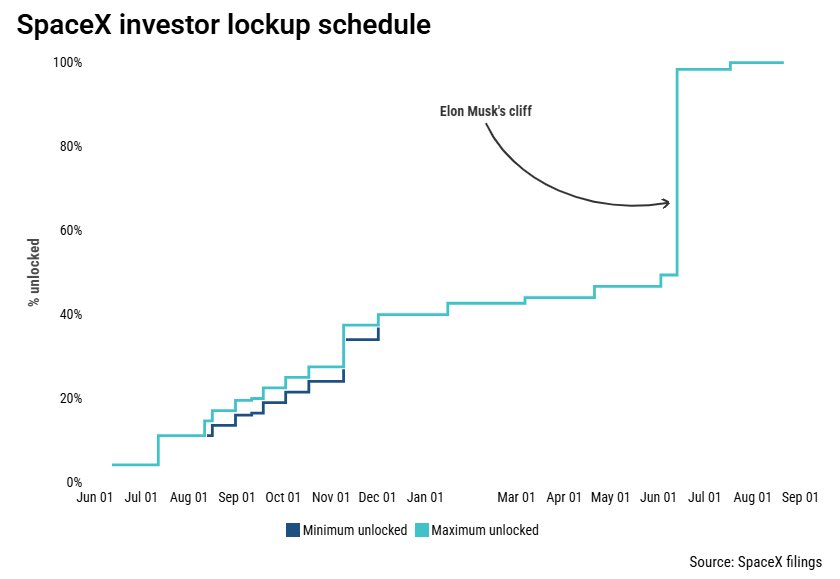
SpaceX released the block in stages rather than one cliff. About 20% came free on August 6, tied to first earnings. Smaller tranches follow every few weeks through October, a larger release comes after Q3 earnings, and the rest of the 180-day block frees up December 8. Elon's own block of roughly 6.4 billion shares stays locked until June 2027.
Passed On The IPO, But Owned It Anyway
I didn't buy the IPO. I wrote about why in Risky Exit Liquidity: Why I'm Passing On The SpaceX IPO. It felt too risky at a $1.2 trillion valuation to invest new money.
There was also a mechanical reason. Fidelity, my main brokerage, enforces a 15-calendar-day holding period on IPO allocations. Flip inside that window and you're banned from IPO participation for six months. Not a trade I wanted to be locked into.
But I already owned SpaceX through a traditional venture capital fund. I just didn't know exactly how much or when the shares were purchased.
When The Fund Purchased SpaceX And At What Price
Back in 2022 I committed $200,000 to a traditional venture capital fund vintage, a year after the mania died down. A fund like that invests most of the capital over a three-year period, and you don't know exactly what it bought, how much of it, or at what valuation until well after the fact.
The March 31, 2026 capital statement showed SpaceX at 9.5% of the fund and my ending balance at $348,549. So a 9.5% position implied about $33,100. That was the extent of my knowledge.
Then the distribution letter arrived on August 7, 2026, with the details regarding the price of purchase and the date.
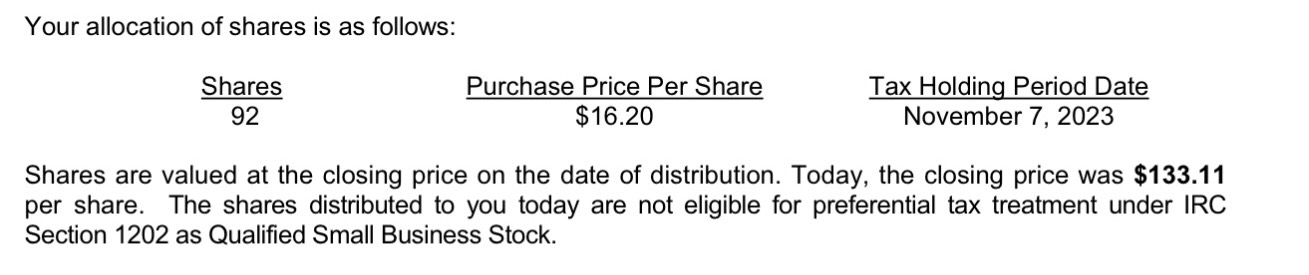
The fund bought SpaceX at $16.20 a share and distributed shares against a reference price of $133.11.
That's an 8.2X multiple on invested capital in two years and nine months. On paper it's a fantastic return.
Now the part that brought me back to earth.
Need To Invest Big Money To Make Life-Changing Money
My first reaction to the distribution was disappointment. That's it? 92 shares. About $12,250.
That is roughly what our family spent on 30 days in Honolulu this summer, including flights, three weeks of summer camp, food, transportation, clothing, and entertainment. A whole summer of memories, or 92 shares of a rocket company.
Then I remembered the 92 shares are only 20% of my stake, because the fund can only distribute what's actually unlocked. The other 368 shares come as the remaining tranches free up. So my full position is 460 shares, worth about $61,200 at that reference price.
Better than a poke in the eye. Still not enough to buy a Tesla Model Y Performance out the door at $60,000, since I owe taxes on anything I sell.
For context, my largest individual public holdings are more than 15X the size of this position. If SpaceX fell 50% tomorrow, it wouldn't move the needle. If this were a top-five holding, I may trim a little based on valuation alone. At $61,200, the math doesn't justify the tax bill.
Unfortunately, you need to invest big money to make life-changing money. In 2022, I committed $400,000 total to the venture capital firm's two funds: $200,000 to its early stage fund and $200,000 to its growth stage fund, which owns SpaceX shares. I should have invested more because 2022 is turning out to be a great year.
What I'm Doing With My SpaceX Shares
The prudent investor in me says sell the 92 and let the remaining 368 ride, since they free up over the next several months anyway. Take some off, stay in the game.
The person who doesn't want to be on the government's leash by paying more taxes says hold everything. The company is growing fast, just raised an enormous amount of capital, and betting against Elon has been a losing trade for 20 years running.
The honest answer is that it doesn't matter. $61,000 doesn't change my life, let alone the ~$12,000 I can sell today before taxes. There is nothing I want to buy that cash flow can't cover, which I proved to myself with a 30-day aggressive $40,000 spending experiment in Hawaii this summer.
So I'm holding. There are plenty more starlink satellites to put into orbit to cover the world's demand. The next generation of satellites will be vastly more capable. Demand for AI compute seems insatiable, as AI revolutionizes the world. And maybe there will be exciting new space development programs in the future. I'm curious to see how far Elon can take his space expansion dreams.
The whole point of investing in great businesses is not prematurely exiting a growing field. That principle doesn't stop applying just because the shares finally showed up in my brokerage account. I’ve owned names like Google, Apple, and Meta for over 15 years, bringing healthy returns. It also doesn't hurt that Morgan Stanley has a $300 price target with a $600 bull case.
Another Lockup Test With VCX
What's interesting about the SpaceX case study is that I ran the same experiment twice. I invested a similar amount in Fundrise's Innovation Fund at the beginning of 2023, back when it wasn't listed, and kept dollar-cost averaging into it until February 2026 as a hedge against a difficult future for my children due to AI.
Fundrise announced on July 24 that it was accelerating the lockup expiration on the Innovation Fund (NYSE: VCX) from September 14 to August 13. Previously restricted shares become tradeable on August 14.
Roughly 100,000 pre-listing holders with a cost basis in the $10 to $19 range are about to get liquidity on a stock that has traded above NAV since it listed. The consensus is that it goes down on the new supply.
That is the same consensus everyone had about SpaceX on August 6.
I don't know what will happen. What I do know is that the market spent weeks pricing in the SpaceX unlock and got the direction wrong anyway. The premium in VCX has already compressed substantially from its peak, which looks like the market front-running the event, exactly as it did with SPCX.
The shape is the same. Rocket up after listing, then a slide into the lockup date while everybody positions for the flood.
And here's the question long-term investors have to ask. If you've held VCX for three years, are you really dumping everything in the 20s and low 30s just because it’s liquid?
My Plan For VCX Upon Lockup
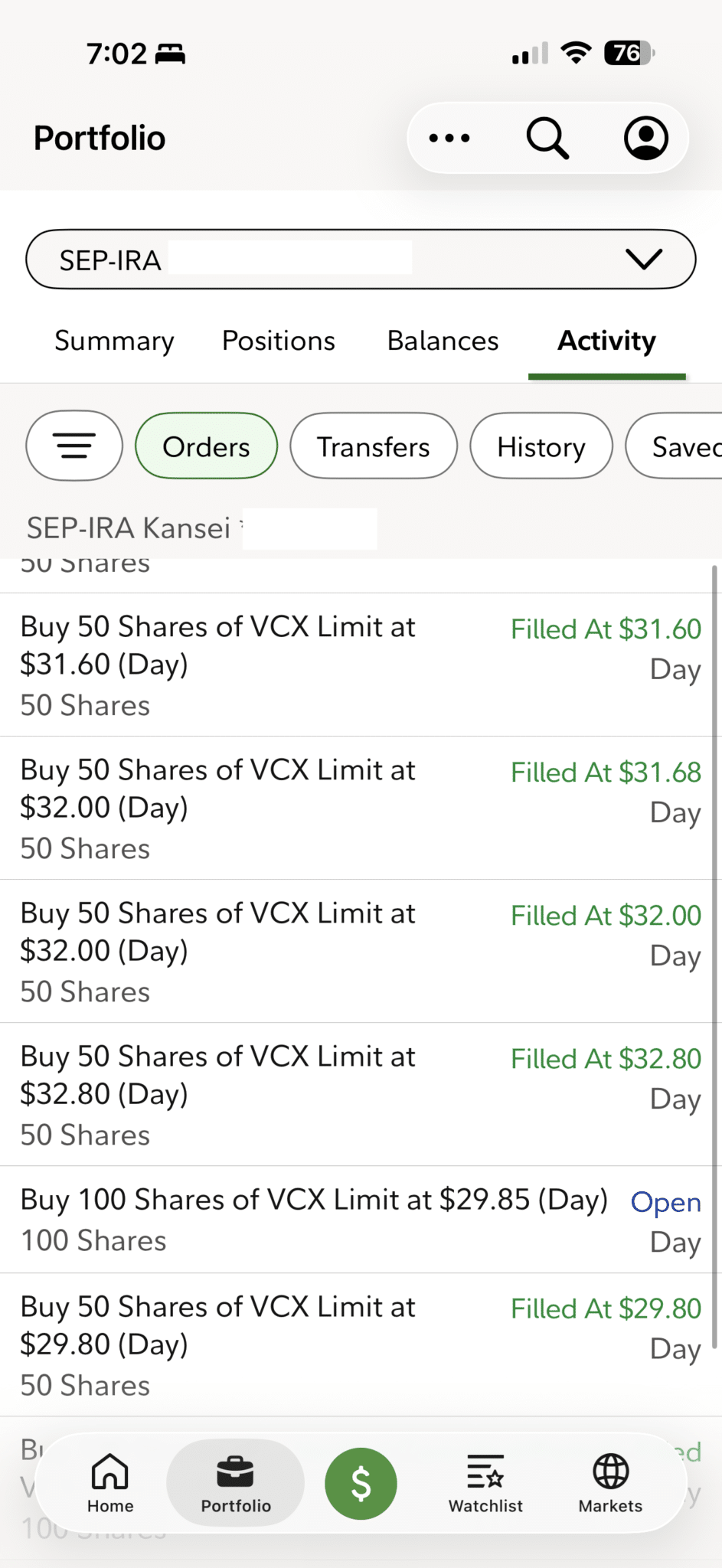
My plan is to hold what I own and buy more after the lockup if VCX trades below my September NAV estimate of $31. I've already taken profit selling my unrestricted shares when valuations were aggressive. Right now, valuations are reasonable.
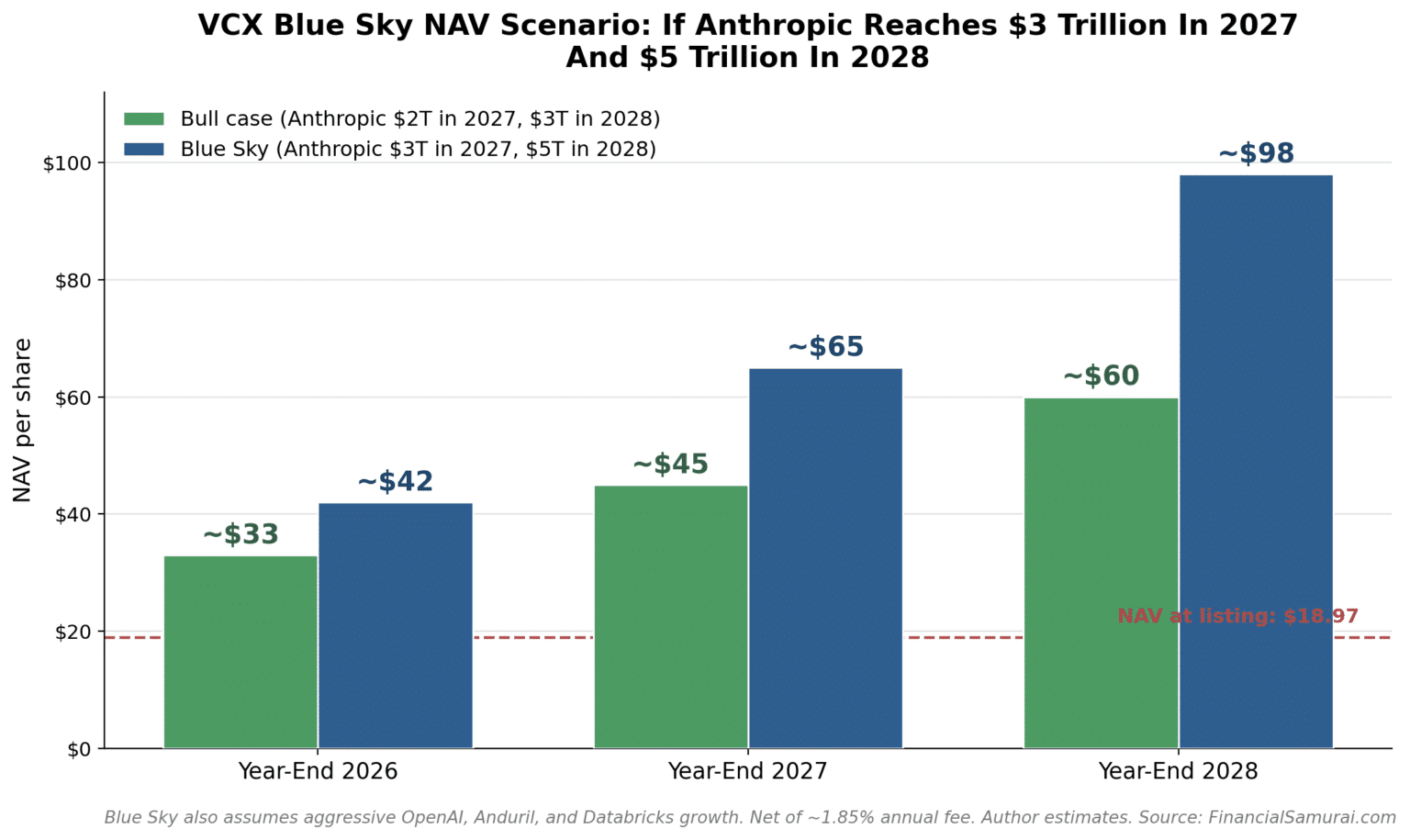
I find it uncanny that VCX is trading right around my NAV forecast put out a month ago, the day before the lockup expires. Maybe my base case NAV forecast of $45 in 2027 and $60 in 2028 will come true too. Only time will tell.
The further it falls below $31, the more I buy. If it hits $25, I plan to back up the truck. I've set aside about $150,000 for the event across four of my portfolios.
The reason is Anthropic, and the potential for retail mania to return. Sitting in San Francisco, watching buyers front-run each other in home bidding wars, and talking to venture capitalists, angel investors, and people working inside the AI labs, my read is that demand for an Anthropic IPO would be groundbreaking. I put that probability at 80%.
I could be wrong. 80% is not 100%. Meanwhile, robust demand during the Anthropic IPO may curiously not ignite VCX again, which has more than 20% of the fund in Anthropic. But I'd rather own the exposure before the event than fight for it on day one with everybody else. Battling for hot IPO shares is a losing proposition.
It's the same reason I'd rather buy my dream San Francisco home before thousands of AI workers get liquid than bid against them at an open house.
The latest reports from the WSJ have Anthropic going public in September or October of 2026. Therefore, the timing of this lockup expiration couldn't be better.
Meanwhile, on August 13, both Bloomberg and The Financial Times came out saying Anthropic is seeking a $2+ trillion IPO valuation based on 20X year-end $100+ billion in expected revenues. If that happens, my base case 2027 NAV estimate of $45 is too conservative and my Blue Sky scenario of $60-$65 is now potentially in play.
My cash is ready to buy the dip. And if my game plan doesn't work out, that's just the way things go with risk assets. At least I came up with a plan and tried.
Full disclosure: I've been a Fundrise affiliate partner since 2016 and I own VCX shares I bought before it listed. About 5% of VCX is in SpaceX and over 20% is in Anthropic. Risk assets can and do lose money. Please invest at your own discretion.
The same 2022 vintage traditional VC fund that held 9.5% of its value in SpaceX also holds 14.3% of the fund in Anthropic, as of the March 31, 2026 capital statement when Anthropic was valued around $360 billion. Meaning my share of Anthropic is worth about $101,000 at a $960 billion valuation.
My goal is to own at least $500,000 worth of Anthropic shares before IPO, which is why I’m a buyer of VCX here. As a FIRE investor since 2012, I need to earn investment returns to provide for my family since I don’t have a day job. As a result, I cannot afford to be too wrong.
Reader Questions
If you own SpaceX shares, did you sell into the unlock or hold? What was the deciding factor?
For those holding VCX through August 14, have you already decided what you're doing, or are you waiting to see the tape?
Have you ever received an in-kind distribution from a fund and been surprised, in either direction, by what actually showed up?
Own The AI Buildout Without A Countdown Clock
Watching a position swing on an earnings print and then swing again on a lockup date is a reminder of why I keep a meaningful chunk of net worth in real assets. Real estate produces income, it doesn't require me to have an opinion by 9:30am, and nobody publishes a countdown clock to my rental property's lockup expiration.
There's a less obvious overlap with everything above too. AI runs on compute, and compute has to physically live somewhere. The hyperscalers are spending hundreds of billions a year on data centers, and every one of them needs land, permits, and power the grid was never built to deliver. The fortunes of the steam era weren't made on the engine. They were made on the railroads and steel the engine required.
Fundrise invests in that buildout alongside residential and industrial property in lower-cost regions of the country. I've invested over $300,000 in its real estate product so far. The investment minimum is $10, so you can test the waters before committing real capital.
Subscribe To Financial Samurai
To get my posts in your inbox, join 60,000+ readers and sign up for the free Financial Samurai newsletter here. For new post notifications, ad-free for the first few hours, sign up here.
Money is too important to be left up to pontification, which is why I've been writing from firsthand experience since 2009.

Hi Tom,
Forgive me if I’m wrong about this, but the math around your SpaceX purchase doesn’t appear to be mathing correctly:
If you committed $200k to a traditional venture capital fund, in which SpaceX was 9.5% of the fund, then your initial SpaceX commit was $19k.
$19k divided by the initial purchase price of $16.20 per share = 1172.82 (so let’s call it 1173 rounded)
So, the total number of shares in SpaceX you should be holding is 1173 (rounded), not 460.
What am I missing?
Thanks for your interest in my investments. I committed $200,000 to the fund in 2022, but the general partners take about three years to Invest 80 to 90% of the Capital.
So they invested in SpaceX in 2023.
When did you invest in SpaceX and how? And what do you plan to do with your Shares? Thanks
So you’re saying that the initial outlay in 2023 for the SpaceX stock eventually purchased in 2023 was 460 shares x $16.20 per share = $7,452 which (at the time) represented 3.7% of your $200k invested with the fund, and then, the subsequent appreciation of SpaceX over the next 3 years grew that amount to represent 9.5% of your ending $350k balance in March?
I bought through a boutique broker in November of 2022. Candidly, it’s the first time that I’ve ever done something like this. I put down $25k for SpaceX at an adjusted cost basis of $16.86 per share.
If I’m doing the math correctly on it, I think it’s worth about $200k now, but I haven’t been able to unlock it yet. Once I do, I’ll probably sell half and let the rest ride. I think it’s a promising investment, but I want to stay disciplined and appropriately diversified with my allocations in my portfolio.
Thanks Sam. I’ve enjoyed your newsletter for several months now and owe my current vcx and fundrise investments to you. I’m curious about the value of vcx long term. To my knowledge, the management hasn’t adjusted since spacex went public. If they do the same with anthropic, then a large percentage of the fund will be holding public companies. Why not sell vcx and buy the public shares directly at that point, especially if there is some mania around ipo? Does vcx just continue to run as is until all the holdings are public? Will fundrise start a new vc fund with the next gen of startups? Any ideas?
Hi Gary – Congrats on your investments success. If you’d like to support, you can pick up a copy of Millionaire Milestones and leave a review on Amazon and a review of my podcast on Apple.
You can definitely try and buy Anthropic’s stock at the IPO. But the question will be at what price and how much you’ll be able to get.
See: The Futility Of Chasing A Hot IPO And What To Do Instead
Good morning Sam,
In the process of transfering my VCX shares to Schwab. Is Computershare considered a “Custdodial” account? Schwab presents several types of accounts to choose from, “Custodial” being one.
Good question. No, I don’t believe Computershare is considered a “custodial” account in the way Schwab uses that term. Computershare is the transfer agent holding the shares in your name. If you’re transferring the VCX shares into your regular Schwab brokerage account, I would select the regular brokerage/individual account rather than “custodial.” Since these are restricted shares, though, Schwab may have some additional requirements for the transfer.
Thank you. I must have missed individual selection when first looking into the process. Found it. Much appreciated.
22k shares pre ipo. Bought some more at $30 a share this morning. I’ll hold for the long term as there is nothing else worth buying in lieu of vcx and s and p 500 right now. Initiated my transfer from computershare to fidelity which apparently will take till next Thurs to finalize.
Thanks again Sam for the free insight !
Wow VCX 47 premarket and hit 28.1 just after market opened. That is your load-up zone Sam! Did you get it? I got in at 34 yesterday but didn’t add yet. Incredibly volatile and hard to figure out what dilution will mean. Looks like trending down toward 28 again. I’ll probably see if that holds before adding.
Yes, bought some today. Feel blessed to be able to build my Anthropic position at these levels before IPO.
Great volume today too at almost 3 million shares traded. The more the better as the shareholder base resets.
Where do you see these prices? I had a limit order for 7 days (Aug 19) and it hasn’t been executed. I also don’t see dips below 30 in my broker UI.
Ah, sorry. For some reason my mobile browser was showing “5 days ago”, while in reality it was 12 days already.
Thanks for writing about this. It makes me feel a lot less alone! I don’t know many people (only one, actually!) who have bought VCX.
I hold about 4,600 shares and still haven’t decided what to do, even though the lockup expires in less than 12 hours. If I sell, the proceeds will go straight into VTI. About 20% of my liquid portfolio is in individual stocks versus broad market index funds, and I count VCX as an individual stock since it represents roughly 4 to 5% of my liquid investments.
Part of me wants to keep it all and let it ride, another part wants to compromise by selling 50% and keeping 50%, and the “old, boring” investor in me just wants to liquidate everything into VTI or QQQ and stop worrying, knowing they’ll eventually make their way into the major indices anyway.
But I do need a bigger nest egg to feel comfortable maintaining FIRE with less worry. (Does that anxiety ever fully go away?) Having individual stocks that I believe in I think will help me get there faster (similar to your google example)
No problem! You can share some your VCX shares to me at $31 if you wish :)
Worry and anxiety declines over time as your net worth and passive income grows. But it will never fully disappear. That’s the fun of it though. Enjoy the financial journey!
Excellent insight and analysis as always, Sam. I was really hoping you would put something out about VCX soon. The SpaceX take was a bonus! I’ve been watching the VCX wave as well as a shareholder starting my accumulation in about 2024. I also bought SpaceX after the IPO when it started to come back to earth. I too am holding both for the long run. I’ve owned Tesla stock since about 2016, when I gave my then high school age son some money to play around with in the market. He bought Tesla which went up about 100% that year. I still remember him saying “What’s so tough about investing, Dad?” Classic! I, too, have learned to never bet against Elon. The guy is a genius and I’ve enjoyed watching the number of people trying to take a flamethrower to whatever he was working on that year only to see his net worth grow again, taking millions of investors with him! I’m in for the full ride. We’ve survived the first half of the roller coaster… can’t wait to see what’s after the corkscrew!!
“I still remember him saying “What’s so tough about investing, Dad?” Classic!”
Hah, awesome. Very dangerous making a huge return so young! He needs to pay some tuition by making some investments that go down 50% as well to help him control risk in the future.
At the same time, you can’t get him so jaded that he never invests.
FT and Bloomberg are reporting Anthropic wants to IPO at $2+ trillion valuation, up from $965 billion in May 2026. So my Blue Sky scenario is now in play.
Good luck to us. No risk, no reward.
I had a sell strategy but it’s changed to a hold based on the pullback toward NAV. Currently adding more. Can’t forecast what fund (RVI, DXYZ, VCX) will be the ultimate winner so I’ve just been buying all three.
Oh wow, gosh IPOs are just so hard to figure out and get right especially with all the hype and uncertainty around them. And the lockup period is another piece that can really complicate thing. I really like your point though about having a plan and sticking with it when the bigger picture hasn’t changed. Helps to pull the emotion out of it. Always enjoy hearing your experiences and perspective on this stuff. thanks!
Great analysis. DXYZ is up 45% so far in anticipation of the Anthropic IPO.
Once the lockup overhang for VCX is over, I expect the buying to be aggressive.
Very thankful to have sellers here and to be able to buy. It’s a good game plan.
I enjoyed the post. Curious – if Anthropic shares will be the driving force why VCX may trade up again, why are you including those shares after it’s IPO? In other words… why do you calculate VCX trades into the ranges on your bar chart if Anthropic has already gone public?
The key distinction is that Anthropic going public doesn’t mean VCX no longer owns Anthropic shares. VCX would still own those shares, but they would become publicly traded and therefore much easier to value.
So my $45 2027 and $60 2028 base-case NAV estimates aren’t dependent on Anthropic remaining private. In fact, an Anthropic IPO could help the market better recognize the value of VCX’s Anthropic position, particularly if Anthropic trades up after going public.
The bigger catalyst I’m thinking about is the valuation reset and liquidity event, not simply the fact that Anthropic is private. If Anthropic IPOs at, say, a $1T valuation and then trades to $1.5T, VCX’s stake becomes worth more regardless of whether Anthropic is public or private.
Im holding. I have just over 4600 shares.
You have given me the idea of buying more if the price falls, but then the transfer would be actively traded in my brokerage account which means I would have to start paying 0.9% on those AUM. It would be worth it, and more if I start executing the trades myself, but as a physician and practice owner, I have a busy day job.
Thank you for all of your great education and perspective.
0.9% is nothing for the ability to own this generational private companies. Once you start investing in traditional VC where they charge 2% and charge a 20-50% carry is when the 0.9% fee really starts feeling cheap.
Hey Sam, fascinating article. Long-time reader, just here to say thanks and that I really enjoy these VCX / stock market / private venture perspectives you’ve been publishing lately. Thanks for sharing your thought process!
You’re welcome! Thanks for reading.
Great analysis! Thank you. I have a modest sum of VCX and will be holding for a while. Will keep an eye on it over the next 3 months and then make future decisions.
You’re welcome! My original goal was to own for 10 years, so 3 years in, I’m excited to buy more.
For example, I started buying Google in 2011-2012, and still own it. It’s now over a $1 million position from the initial $50,000 investment.
Buy and holding great companies and the S&P 500 is the way!