
After publishing The Untold Burden Of Being Your Family's Financial Provider, I got this comment from a reader named Brian:
“I can identify with this post as I am the family CFO / CIO. I think you are WAY overcomplicating this. What is wrong with merely investing in VTI / VXUS and chill? My returns have been 12%+ for doing nothing but DCA into them every month. Going on 20+ years (mutual fund shares before ETFs) it has worked.
I realize you write a blog and invest in two ETFs and be done isn't nearly as exciting but talk about mental load lifted! Zero mental effort into investing allocations, decision, valuations, PEs or any of that noise. I focus on tax planning and asset location. All else is supplemental but would not create very interesting content!”
Brian is right about the mental load. He might also be right about the returns. Two funds and a monthly transfer is one of the best risk-adjusted decisions a person can make, and the majority of my public equity capital sits in the S&P 500 for exactly that reason. Most professional money managers can't beat the index. Retail investors have even worse odds.
But there's a catch nobody mentions when they tell you to buy the index and chill. If you only own the average, you only get the average. And the average, by definition, does not get you ahead of the people you are actually competing with.
Owning The Index Means Owning The Average
Say the S&P 500 returns 12% this year. You're up 12%. So is every other index investor you know. Congratulations, nobody moved, just like how nobody's view improves if everybody stands up at a stadium.
The problem is that the things you want to buy with those gains are bid on by the same people who just got the same 12%. The house on a big lot in the better school district. The remodel. The private school tuition. The two weeks in Hawaii in July, when everybody else also wants to be in Hawaii in July.
Scarce assets don't get cheaper because your portfolio went up. They get more expensive, because everyone else's portfolio went up too.
Wealth is partly absolute and partly relative. The absolute part pays for groceries, gas, and the electric bill. The relative part decides whether you get the house on the hill with the enclosed front yard or the one two neighborhoods over with loud noises all throughout the night. Index funds pays the bills, not the luxuries.
The only way to win the relative game is to outperform the people playing it with you.
Nobody Grows Up Wanting To Be Average
Think back to when you were a kid. Did you tell yourself you wanted to be an average soccer player? An average artist? An average singer?
Of course not. You wanted to be the best at something, anything. And that instinct was healthy. Being in the top 1% of one thing does wonders for your self-esteem, even if that thing is competitive spelling or beer pong.
Then life beats it out of you. Competition gets fierce. You give up your hobbies for meetings about nothing consequential. You stop exercising because the corporate ladder demands it, and you end up heavier and unhealthier than you'd like. To numb the ennui, you spend more in the name of YOLO.
By the time you hit 60 and start thinking about retirement, you're less healthy than you planned to be and you have far less in your 401(k) than if you'd simply maxed it out every year.
That is the average American path. Is that really the benchmark you want?
The Median Is An Even Lower Bar
Here's where it gets uncomfortable. The average American household is doing much better than the median one. The Federal Reserve's Survey of Consumer Finances put average household net worth at over $1 million against a median of roughly $192,000.
That gap exists because a small number of very wealthy households drag the average up. So when someone says they're “above average,” ask which average.
Yes, if you consistently buy an index fund for 20 years, you will crush the median American who owns almost no equities at all. The median American might be the person in those popular surveys who can't cover a $1,000 emergency without reaching for a credit card.
But you read Financial Samurai. You know what a safe withdrawal rate is. You know what the risk-free rate is doing. Go talk to a random person about asset allocation or venture capital and watch their eyes glaze over. They're too busy running a sub-5% savings rate and funding their lifestyle at 24% APR.
Those aren't your competition. Comparing yourself to them is how you talk yourself into settling.

The Two Levels Of Rich
Over the past 30 years, I've observed two levels of rich. If you've decided you want to build wealth, then you must decide between the two.
Level one is the disciplined index investor. Dollar-cost average for 30 years, work until 60, retire with a comfortable nest egg and a paid-off house. This is a genuinely good outcome and I'm a fan. It’s also easier to sell.
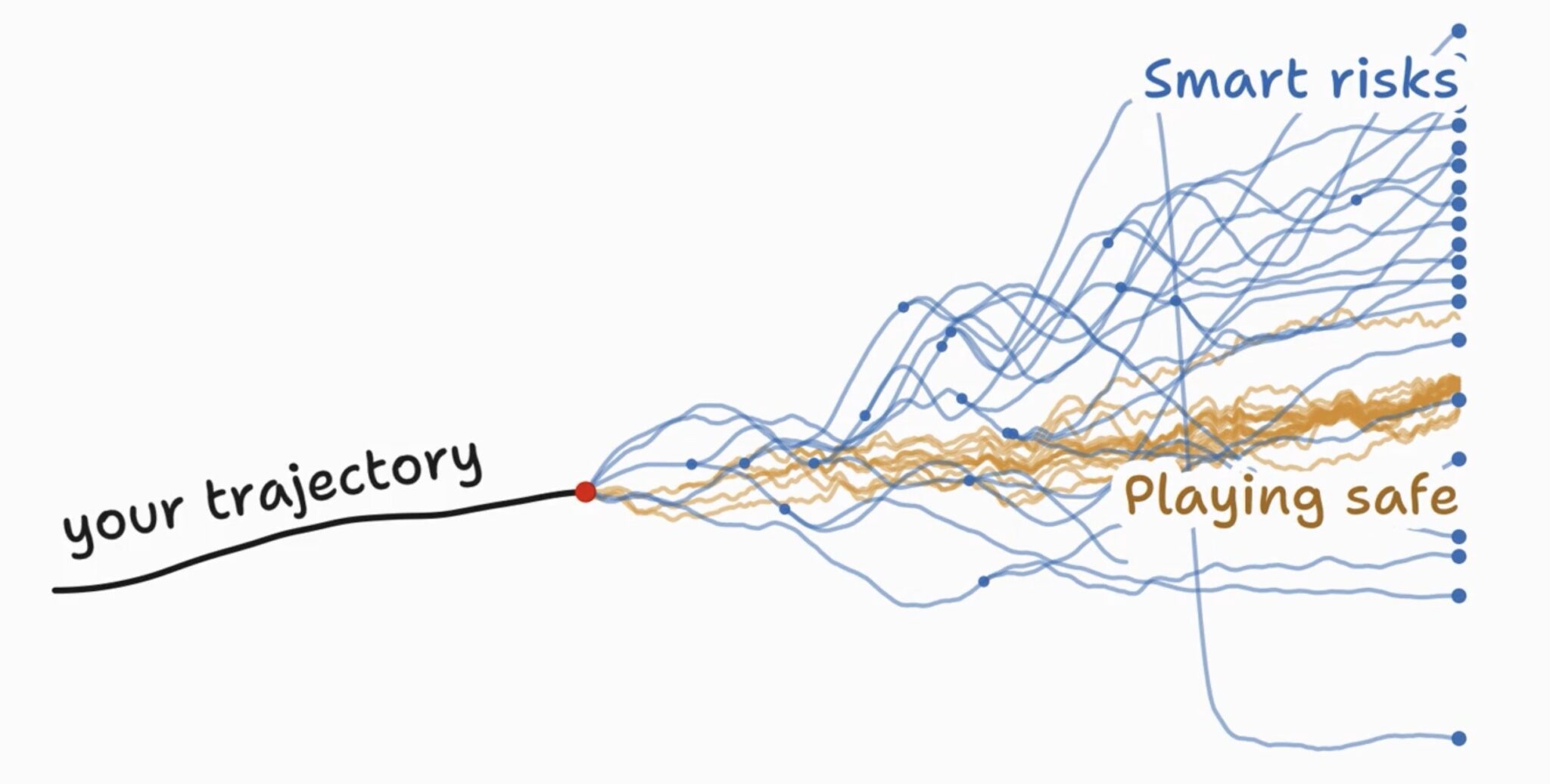
Level two is several multiples higher. These are the people who start businesses, concentrate into individual companies, and make outsized bets. They don't view index funds as a wealth creation engine. They view them as a place to park capital when they don't have a better idea.
There's no right answer here, because there's no free lunch.
Chasing level two means accepting that you might lose a significant amount of money, time, happiness, and some of your health along the way. Every wealthy entrepreneur you admire has a story about extensive misery.
The honest framing is this: taking more risk means you will lose more often and lose bigger than the person who doesn't. That's the entry fee.
Why I Took The Risk
I moved to America at 14 after living in Malaysia, Taiwan, Japan, and The Philippines, and what struck me first was the abundance. Food, clean water, safe streets, a stable government. Surviving here felt easy compared to what I'd seen. I got a $4.25 an hour job at McDonald's in high school and felt lucky I could eat all the apple pies I wanted.
But a friend died at 15, and that taught me something the abundance didn't. Life is short and there's no guarantee you get to enjoy a two or three decade retirement. The only hedge I could think of was to study harder, work harder, save more, and invest more aggressively than average.
FIRE was in my head by 1999, my first year in finance. I knew I couldn't survive 60-hour weeks for two decades, which meant I had to take more risk to compress the timeline.
So I did.
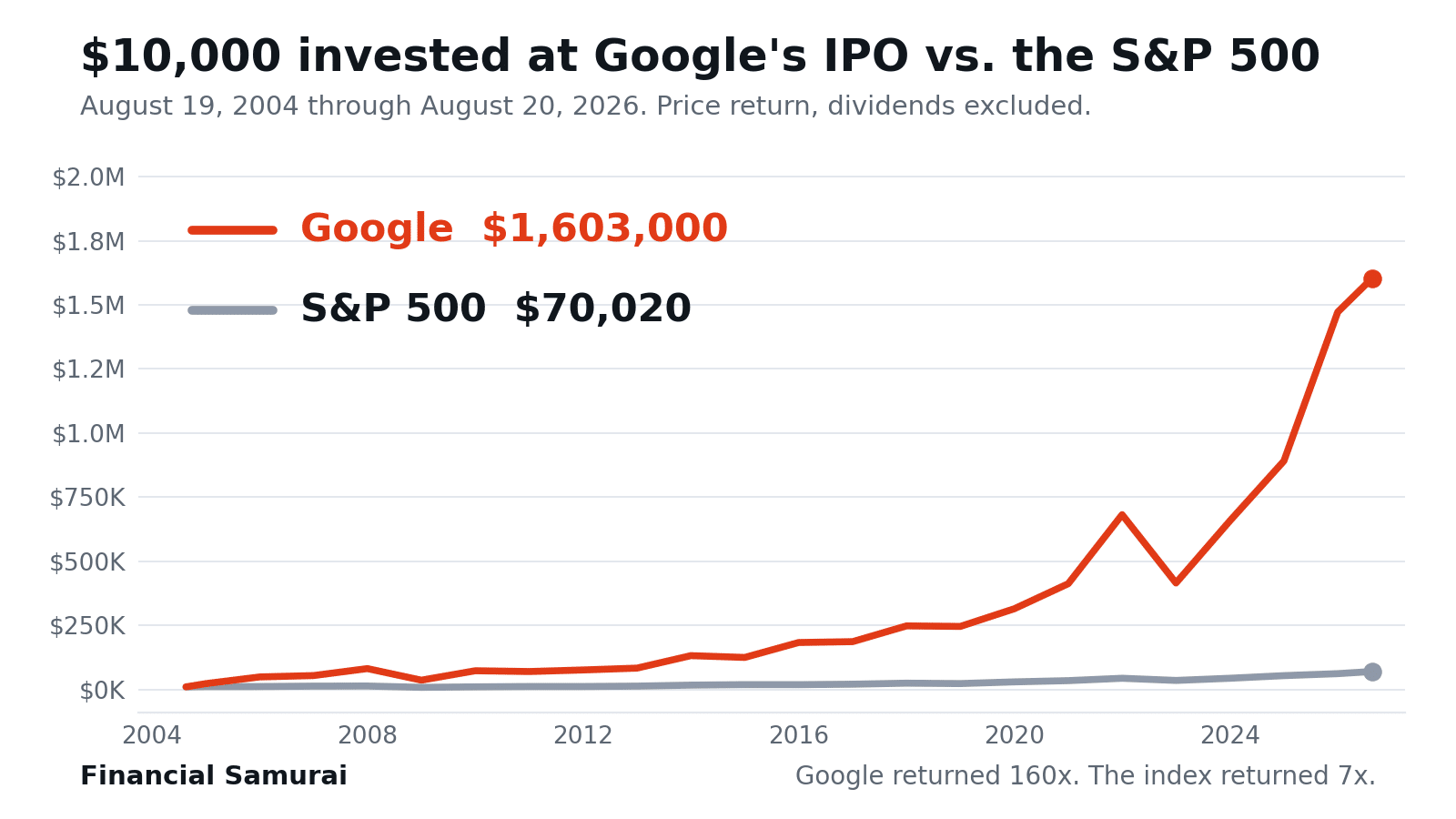
In 2000, I bought a speculative Chinese internet company called VCSY that ran up 50X and then went to zero when the dot-com bubble collapsed. I took what was left of those proceeds and bought a $580,500 condo in 2003 with a $464,000 loan. Two years later I levered up again and bought a $1.5 million house with a $1.2 million mortgage, and renting the condo out.
Looking back, that was an insane amount of leverage for a 28-year-old. But I believed San Francisco real estate was good value, and I wanted enough passive income to walk away by 40. Today, I still think San Francisco real estate is some of the cheapest in the world compared to how much income and wealth you can build.
I reinvested 90% to 100% of the 50% – 70% I was saving each year into risk assets. Most of it went into San Francisco property and growth stocks like Google, Apple, and Tesla, not the S&P 500. When things were good the portfolio flew. When things were bad it hurt like hell.
There is no version of this where I retire in 2012 at 34 by buying the index and chilling. Maybe by 55, but definitely not by 34.
Dial Risk Down Once You've Made It
Once you've broken free, or built enough that your spouse can, that's when you reduce risk. Shift more capital into index funds. Buy individual Treasury bonds and lock in the risk-free rate. Stop needing to hit triples and home runs.
But here's the irony. Because you already have enough, you can also afford to take more risk at the margin. The constraint isn't the math, it's your sleep. If a position has you refreshing quotes all throughout the day when you're supposed to be present with your children, you've taken the wrong size and you've got the point of financial independence backward.
Right now I prefer the risk-reward on VCX in the high $30s to the S&P 500 after a roughly 13% run. I'd guess the S&P 500 finishes the year somewhere between up 5% and up 20%, which is down 8% or up 7% from here.
VCX I could see going from $38 down to $28 or up to $60 by year end. That's a 26% drawdown against a 58% gain. As a rational capital allocator with idle cash and the stomach for volatility, I'd rather own the asymmetry. I want to benefit from any potential Anthropic IPO frenzy.
If I'm wrong, I lose money or I make less than I would have. That is the entire downside, and I've already accepted it.
Everything Is Rational In The End
Brian isn't wrong. He's optimizing for peace of mind, and peace of mind is worth a lot. I'd never argue someone out of an S&P 500 index ETF.
But don't confuse a low-effort strategy with a high-return one. Investing in index ETFs will make you comfortable. It will rarely make you exceptional, because you're buying the exact same thing as everybody else you're bidding against.
The question isn't which portfolio is correct. It's which trade-off you actually want. Less risk and a predictable average, or more risk and a shot at above average, with the very real chance you end up below it.
When it comes to money, I'll take the calculated risk every time I think the odds are in my favor.
Readers, where do you land? Is index-and-chill enough for you, or are you still hunting for level two wealth? What's the riskiest financial bet you've ever made, and did it work out? And for those of you who've already reached financial independence, did you dial risk down or dial it up?
Protect The People Who Didn't Choose Your Risk Tolerance
Taking more risk only works if a bad outcome doesn't take your family down with it. I levered into a $1.5 million house at 28 with a $1.2 million mortgage. If something had happened to me that year, my wife would have inherited a hefty $6,800/month payment, not a portfolio.
That's the difference between calculated risk and reckless risk. Calculated risk has a floor under it.
Term life insurance is the cheapest floor money can buy, and it's what lets you concentrate, lever up, and swing at level two wealth without gambling with people who didn't sign up for it. Check your rates on Policygenius. It takes a few minutes and the quotes are free. I locked in a 20-year term policy during a refinance and my stress level dropped more than any asset allocation change ever did.
Invest In The Physical Side Of The AI Boom
If you want exposure to the biggest capital cycle of our lifetime without picking a single stock, look at where the money physically lands. AI is a general-purpose technology, and general-purpose technologies need infrastructure. Compute has to sit somewhere, drawing power, on real land.
Hyperscalers are spending hundreds of billions a year on that buildout, and McKinsey pegs the total need at roughly $7 trillion by 2030. The binding constraint isn't chips. It's power and permitting.
That's a real estate story dressed up as a technology story. Fundrise gives you access to that side of the trade with a low investment minimum. I've invested over $300,000 with Fundrise, and it's the passive way I get exposure without becoming a landlord again. Fundrise is a long-time sponsor of Financial Samurai.

“the point is that if everybody is returning/earning what you’re returning, and the cost of all goods goes up at the same rate and nobody wins.” “the average, by definition, does not get you ahead of the people you are actually competing with.” I guess if “average” is every Silicon Valley finance or tech bro, you’re in trouble.
Yours is a tough view on life (and the definition of “average”) if you are trying to optimize happiness. I’ve taken some risks and I’m fairly certain I’ve beaten the S&P 500 but I would be just as happy had I “only” matched the S&P 500 and have been “average”. I certainly have beaten the average and median in terms of net worth.
When we watch people gamble in Vegas at the $25 or $100 chip tables, my wife wonders how people have so much money. Same when we visit a high-end resort and she marvels at the wealthy people. Our kids’ private school are lined with Range Rovers while we drive our Honda and Mazda. I have to constantly reassure her that we could afford all those things, but I certainly understand why my numbers on a spreadsheet that I maintain is less impressive than a Range Rover in the driveway or a house with more than 2 bathrooms.
My wife has a (mis)perception that “everyone” is doing better than us, or at the very least we are only “average”. The empirical data does not support her perceptions. Like you, I’ve studied financial facts and figures for decades now.
People with the same salaries, same number of kids, same opportunities haven’t executed at our level. Sure, there are a few people who have achieved high risk and high reward, but the vast majority people don’t do the “boring” wealth building steps. My wife honestly thinks “everyone” does the following:
We have been extremely fortunate, but I am also extremely disciplined and financially astute. In real life, people have ups and downs, financial setbacks, health problems, family problems, etc. Financial planning is boring and most people avoid it including my wife. Most people–whether it’s the person at a high-roller table, the Range Rover driver, our wealthy dual income working professional friends who are diligent savers–are not doing as well as us in reality.
I get it. The Financial Samurai competes with other Samurai (the AI Samurai, the Crypto Samurai, the Pharma Samurai), but most people are farmers and maybe merchants. I’m happy just to be a Ronin. I have no title, prestige or followers, but I do have some “skills”.
I enjoy reading you and have followed some suggestions from your opinions. However, I don’t see myself competing with others, I see myself as someone who builds wealth that allows me some financial freedom to have choices.
It’s a great attitude. However, the point is that if everybody is returning/earning what you’re returning, and the cost of all goods goes up at the same rate and nobody wins.
So you gotta save more or earn more if you don’t wanna take more risk risks.
Sam, I just wanted to say THANK YOU for all the guidance you post on your site. I wish you could see how much you’ve helped me and my family. We used to tremble when we thought about retirement. Nowadays, we smile and try to keep our excitement to ourselves since most of our friends seem to be planning for the future as bad as we used to.
You give AMAZING advice and share INCREDIBLY helpful info. Should you happen have free time once your kids are grown up, feel free to go fire our president, senate and congress, and run our country as well as you run your business. :)
You’re welcome Jay! Glad you’ve gained that enthusiasm and confidence about your finances. It’s been a great journey so far.
I got into making money late and am an index fund investor to this point. Self employed as of last year, business gives about $120,000 before tax profits to me right now. Going up from there a lot requires hiring and diminishing profit margins, will happen gradually.
Net worth about $330,000 at age almost 34. I spend about $45,000 a year total in my single w girlfriend lifestyle. That will go up with kids soon. Prefer private Christian education.
I live outside the DC metric so medium high cost and not willing to race the commute in city. I work from home. Looking to buy first home next year and marry. She has debt I don’t.
In this lifestyle/income, is it viable for me to have enough to invest t conventionally in a portfolio that would allow me to retire “typically”, like 65, but take more calculated risk above that level to have a chance to half” retire at 40-45?
This is a personal wealth planning question, I know. But I simply do not have knowledge and access to financially advanced social networks with my professional circle being nonprofit fundraisers and consultants in DC market (my field). This is not NYC or SF. The “haves” here are government contractors, lobbyists, and attorneys who all profit off taxpayer, not the market.
Doesn’t it matter more how much you add ie compound each year? Your neighbour might get x% return but then go on holiday etc. You can keep compounding. Besides, while they say the market returns 12%, there are articles out there saying individual investors get much less (because of over-trading etc).
Why not invest in index funds that consistently beat the s and p like QQQ, VGT, SMH, VUG, and also invest in etfs like VOO and VXUS.
“Anthropic seeing the state of market sentiment towards Al, and forcing an IPO anyway, reeks of desperation…”
Who is the quote from? Feel free to elaborate. Thanks
“I understand you can’t time these things perfectly, but I simply think it’s the wrong time after a historic momentum selloff in Al stocks, with yields at multi-decade highs, OpenAl pausing training, more states issuing datacenter pauses/bans, and public sentiment vs. datacenters. Al stocks have been getting tossed since June. Do you think Anthropic could raise a $200B private round at a $1.5T valuation today?” – Stock Talk convo I was following.
“Level one is the disciplined index investor. Dollar-cost average for 30 years, work until 60, retire with a comfortable nest egg and a paid-off house. This is a genuinely good outcome and I’m a fan. It’s also easier to sell.
Level two is several multiples higher. These are the people who start businesses, concentrate into individual companies, and make outsized bets. They don’t view index funds as a wealth creation engine. They view them as a place to park capital when they don’t have a better idea.”
Why does it have to be one or the other? What about people who take risks in business, and then invest the proceeds in index funds? In fact, taking risks across the board (in both creating and growing yourwelath) may be an unwise choice.
That’s more or less what I did. Take calculated risks (30+ year business owner), take risk off the table from time to time, and re-allocate that capital to something less risky. I retired last year at age 59, and now much of my investment thesis is risk mitigation and moving riskier assets into relative safety.
Brian here! Thanks for commenting on my comment! I have combined the average returns of the indexes with way above average income, and way above average levels of savings (40% of our income or more) for a while. You are correct though. Retirement at 34 would not have been possible with my system. It took till 43 for my wife and 48 for me to be financially free. Savings rate is the huge driver in the begining along with income, then investment returns take over. We are working a few more years now (3-4 max) not for consumption reasons but for legacy purposes.
Congrats for being financially free. 48 is still not bad, but you just said you are working for another 4 years? So are you not financially free?
I’ve found that one’s financial independence number is not real if nothing changes. What do you mean by legacy purposes?
When I hit my target of $3 million net worth, I took the leap of faith and left. And negotiating a severance was the helpful catalyst.
Do you really want to trade 40+ hours a week for more money when you’re 48 if you are truly financially free?
You may also like this post: Overcoming The One More Year Syndrome To Do Something New
There’s a 1.5 version of the two choices you have listed.
Find ways to maximize your income without leveraging your capital.
An example: I’m a sales professional and started with standard OTE packages containing a commission and a salary component. What I found was the companies could always limit my upside by making me shoot for a higher quota. I could either bounce around (this gigs version of your choice 1) to secure a reasonable income, or I was fortunate to be in an industry where I could get an uncapped straight commission job.
It wasn’t easy at the start, and there were components of the job similar to being a sole proprietor that I had to overcome, but in time it paid off big. Thing is if it hadn’t I could always go back to what I was doing before – I was only leveraging my time and not my existing capital.
Moral of the story – if you aren’t going full entrepreneurial, the best way to accelerate and maximize your working years is to look for career leverage and be aggressive about it.
I am an all index investor but I reached level 2 wealth by investing far more than the average for my income and most if not all of my profits from my business roughly 1mm per year (75-80% savings rate) into VTI/VXUS/BND religiously, so in a way my risks are all in my business/practice so I dollar cost average twice monthly with my business profits and am okay with average returns since my rate of investment is very high relative to the averages. I will continue to do this and believe I have set myself up well, hopefully.
Really enjoyed the article and squarely put our household financial approach in the level one category. However, I would assert that wealth is a five variable function – variables that you have covered in other articles: Wealth = f(income, savings rate, consistency, risk, luck). As a non-risk taker, and lacking the financial aptitude to identify opportunities, our household has instead excelled at savings rate, consistency, and luck to flirt with level two wealth using the level one approach. I wish we had the knowledge and intestinal fortitude to take the quicker path with higher risk investments, but we’ve done well by compensating with the other financial knobs. Good fortune and health to all!
I think this conversation just shows that each person has different risk tolerances and what is right for one person is not right for the rest. I find having the majority of my stock in index funds allows me to not constantly monitor the news. For me, a set it and forget it mentality has worked out well and I’m happy with where my investments currently stand after 7 years in retirement. I retired early and as you point out the risk you can take in your 20s, 30s, and even 40’s is not what you can necessarily stomach when you are in your late 50’s pushing 60. I have found that I am young enough to still want some more diversity in my stock accounts so I am moving a small percentage (maybe 10%) of my Roth into “riskier” investments (e.g.-individual stocks like SpaceX and funds like VCX, etc.). I can only take this risk because I feel I have the tailwinds to support the risk and I think the reward is worth it. I guess at the end of the day every big decision in life is a risk/reward calculation because so few things in life that are worthwhile are just a “free lunch” without a potential downside.
I respectfully disagree with the notion that winning the competition means acquiring the ability to buy more things. Meaning for me comes from service to others and inner peace. I am fortunate to be able to pursue the “average” path that is somewhat criticized in this post. A path which has afforded me a comfortable/luxurious lifestyle and a wealth that, while modest by SF standards, still puts our family close to the top 10% in the US. I’m not sure who is outcompeting me; I’m pretty sure we’re winning.
yes not caring what anyone else thinks has saved me a fortune, I drive a 2012 4Runner!
Beyond a certain level of financial security, true wealth is measured in the amount of free time you have to do as you please.
Take myself. I went into medicine, had a solid career, and am FI. So I FIREd in my late 40’s. After 14 months off, I decided to go back to work, albeit just 3 days a week at a mellow clinic. I view it as a paid hobby not as a job.
Compare that to my very close friend who is a managing director at Merril Lynch in Manhattan. He makes way more than I ever did. But he is a slave to his career choice. He works at least 60 hours a week and has a 2 hour commute daily. Assuming similar saving and investing habits, his net worth is likely much higher than mine. But he has no free time.
So who is truly wealthy in this scenario?
Just when I thought you were taking a certain track Sam you opened up the optionality of the two levels both being ok which I agree with. Outside of a small initial stock investment during the financial crisis in I pursued a zero risk attitude cycling 100% of my earned income into cd ladders and therefore missing out on the spectacular bull run of the past 15 years, 401k, employer matching, etc., not asking for raises, etc., how dumb. Still I was able to achieve FIRE
by 45 by focusing 100% on the profitability of performance at my job and knowing the goal was FIRE and the only way I felt certain I could achieve this was by managing risk and socking away maybe at a 90% or more savings rate annually by prioritizing aspects of life that I found meaning in rather than consumption spending. The weird thing now and likely not the right approach from the vantage of “winning” is I have a safe treasury bankroll that is covering annual expenses and as i now have the bandwidth to learn more about investing I can allocate the funds I’m earning from treasuries, my wife’s job, my own business and consulting into risks options like stock
so actually and ironically it does not feel risky as bases are covered. I do not value the private school, cars, five star hotels (although my wife has a penchant) as making it. In my life I’ve met many people of substantial wealth who I can understand are disconnected from everyday people, have their own shortcomings, as do I, and that great restaurants are fun, but its hard to find the those places either in the higher price points or lowest in the dining experience that really express excellence and authenticity of culinary artistry but they exist despite a meal being expensive or not and one needs to have a sensibility to find the good place. Contentment is a frame of mind which is also hard to find. I think if you start to consider life as a game that you are winning or losing, you’ve kind of lost already on balance as the perception of losing has a far greater impact psychologically than when you have perceived a win. It’s scary as without reflection you can really sidetrack yourself from the sense of gratitude for what you’re achieving or have achieved once you FIRE by continuing to measure yourself against others, with so many different kinds of metrics to do so. I’m sharing this with the knowledge that I am an imperfect person and working on it and I’ve made mistakes in my life financially speaking, along the way. But I also know there is no such thing as perfection either, maybe excellence, but the idea of absolutes doesn’t reflect the nuance of existence for me in a philosophical way. As recently FIRE’d I really wish to find peace in my heart in a sustained way, daily, a sense of calm to experience and enjoy my life and relationships deeply, which is what I think the insane risk taking working effort I made to get to this place was all about.
I’m naturally contrarian and bearish and so I just don’t feel comfortable with index funds. I try to reduce downside risk and maximize return for a given risk budget. I also enjoy finances. Pre-2012 I just did a lot of crazy stuff including over-leverage and had bad returns. Post 2012 my returns are OK, still looking for big wins though in gold, bitcoin, venture etc.
Enjoyed the post quite a bit. I didn’t think I was a risk taker until I met with my cfp and realized that I invested in 2 friend’s start-up over the years, and kept my equity awards for 20+ years. (Concentrated positions now), and then I invested in real estate (properties and fundrise) and I invested in VCX.
So now I am trying to change my perception of myself.. maybe now I am just “reckless” versus average.
I really enjoyed this post and found myself nodding throughout reading it. This is such a great example of how investing can be so personal and what one person feels is the best avenue does not align with another’s.
This line was one of my favorites: “If you only own the average, you only get the average. And the average, by definition, does not get you ahead of the people you are actually competing with.”
And also your points about comparing oneself to the median or not. We all have to decide where we want the bar to be and for some people it’s much higher or lower than others. You make a very fair point too that for those who actively take on higher risk in the hopes of outperforming average should be willing to take on the risk of greater losses in the process.
This was a great read, thank you!
I enjoy these kind of posts that engage with an interesting user comment. I enjoy other posts, but I don’t live in SF, or invest in VC or real estate, so they don’t always resonate as much. Anyway, I appreciate your thoughtful topics.
No problem. Luckily, you can take risks wherever you are. Doesn’t have to be in SF.
All my above average returns have occurred as a result of knowing WHEN to take the win and knowing HOW to take the loss.
If we’re talking about competitively outperforming the average, median, or financial samurai investor, we’re looking at it from the wrong angle. It’s less about taking bigger risks on individual stocks or factor ETFs and more about your savings and investment rate. The “risk” worth taking is increasing how much of your income you save and invest, not betting on individual stocks in hopes of a moonshot.
When I was younger, I was fortunate to be successful as a “level two” investor with real estate. However, I am now happily a “level one” investor and putting all current and future income into index funds (with maybe a little play money going into SPMO and VGT).
paraphrasing Buffett: get a big enough shovel and your returns will be great. That is my strategy. put tons of money into the index and let it do the work.
I have multiple personal examples over 30+ years of entrepreneurship and other calculated investment risks (including Fundrise & VCX). I can tell you that my return was far higher than 12%. In fact, I would comment to fellow business owners (in the IT services space), if you are not making at least 20% profit year over year on top line revenue (After you pay yourself a reasonable salary), you might as well just get a job. That’s because the level of risk of owning a business demands a higher return. Getting a regular job is like investing in two index funds and calling it good. There’s nothing inherently wrong with that approach, but as you state: it’s merely average. My net worth is more than double the 55 – 64 figure you cite as the Financial Samurai target (I’m 60 and retired a year ago).
Great post Sam as always. I have always wondered about this.
Only about 7% of investors can “beat the market”
Reference(https://www.ngpf.org/blog/question-of-the-day/question-of-the-day-over-a-recent-20-year-period-what-percent-of-pros-investing-in-large-companies-beat-the-market/)
I think the John Bogle approach is best more the vast majority of people. Keep in mind you have education and knowledge about investing that most people don’t have. I work in healthcare, I can barely understand half of the terms in accounting and finance!
For any individual investor you would have to try active investing for 10+ years to see if you can do better than average otherwise the John Bogle approach is best. Even Berkshire has struggled to beat the S and P 500 in the past 10 years if I remember correctly. Of course Berkshire is working with billions and they have to buy almost an entire company etc.
Lastly this great quote from Ben Graham:
“To achieve satisfactory investment results is easier than most people realize; to achieve superior results is harder than it looks.”
― Benjamin Graham, The Intelligent Investor
Yes, if you want to outperform the median person, invest all in index funds. But if you want to try and outperform the average person who invests in index funds, taking more risk is necessary.
It all depends on what stage of your financial life you’re in, along with your objectives.
Just because the SP500 has averaged a 12% return over the past 20 years does not mean the average investor returned 12% per year. It is extremely well documented the average investor does worse than the SP500.
It would be like saying the Mag7 have averaged a 20% return over the last 10 years, therefore you shouldn’t have invested in the Mag7 during that time because you’d have only gotten average returns.
Sure, but we’re not arguing that point. Let me know how you invest and how you view outperformance and the effort and risks it takes. thx
The greatest investor of all time did win the legendary bet of index fund vs managed hedge fund after ten years. That being said, why not take a some risk if it’s a small part of your world?
I didn’t mean to argue how one should invest. I just wanted to point out that every study I have read says if you get the SP500 returns you are a significantly above average investor.
You are absolutely correct. My actual returns have been higher than the averages by investing in the averages regularly by dollar cost averaging every month. :)